Do You Actually Need a Bodyguard? An Honest Checklist
Miami Protector · · 6 min read
Most people who ask this question do not need a bodyguard. You should hear that from someone who sells the service, before anything else, because the honest answer saves you money and a security firm that leads with fear is telling you something about itself.
That does not mean no one needs protection. Some people clearly do, and for them the decision is not close. The purpose of this page is to help you tell which group you are in, using the same questions a professional would ask on the phone, without a sales pitch attached.
What a bodyguard actually is. A bodyguard is a licensed protection professional assigned to keep one specific person safe. The real work is not physical confrontation. It is attention, planning, and discretion: noticing a developing problem early and moving someone out of it before it becomes an incident. Most of a competent detail is finished before anything happens. Keep that in mind as you read, because it shapes what protection is actually for, and what it is not.
When protection is genuinely warranted
Protection earns its cost when something specific has changed. These are the triggers that make the decision clear, with the kind of example that usually sits behind each one.
A credible, specific threat. Not a general unease, but something you could describe to a detective: a named person, a message, a pattern of contact that has not stopped. The test is whether you can point at it.
A moment of concentrated exposure. A public appearance, a product launch, a gala, a court date, a week when your name is in the news. The risk here is not constant. It spikes around one event or one window, and so does the case for coverage.
A contentious situation. A difficult termination, a business or family dispute, a legal matter, someone who keeps showing up where you are. These create a specific person with a specific reason, which is exactly what protection is designed around.
Travel into unfamiliar ground. A city you do not know, a schedule built by someone else, arrivals at hours when you are tired and visible. Exposure concentrates in the gaps between controlled places, and a stranger to the city feels those gaps most.
A family member whose profile creates risk. Often the person asking is fine, and the exposure actually sits with a spouse, a child, or an aging parent whose routine is predictable and public.
The honest checklist
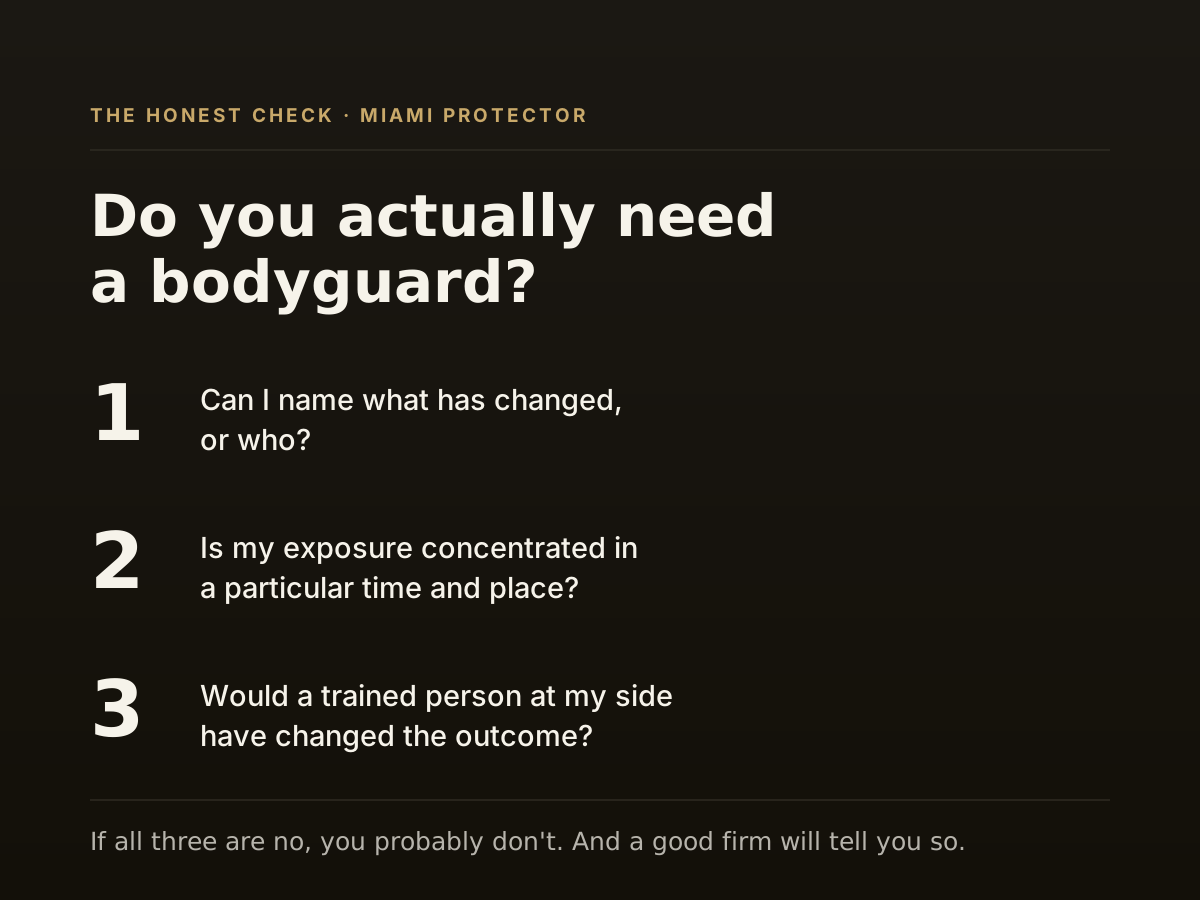
Three questions sort most people in about a minute. Answer them plainly.
1. Can I name what has changed, or who?
If you can point at a specific person, message, event, or change in your circumstances, that is a real signal. If the honest answer is a general feeling that the world is dangerous, that is not a protection problem, and a detail will not fix it.
2. Is my exposure concentrated in a particular time and place?
Protection works best against concentrated risk: one event, one trip, one stretch of weeks. If your concern is spread evenly across all of ordinary life, the answer is usually better habits and awareness, not an officer at your side.
3. If something did happen, would a trained person at my side have changed the outcome?
This is the one people skip. For some situations, a professional nearby genuinely changes what is possible. For others, the honest answer is that a bodyguard would have been a bystander too. Only the first kind is a protection problem.
If the answer to all three is no, you almost certainly do not need a bodyguard, and anyone telling you otherwise is selling. If any answer is a clear yes, it is worth a conversation with someone who does this work. If you are in between, the section below is for you.
When you do not need one
This is the part most companies leave out, so here it is plainly. Everyday life in Miami, for most residents and most visitors, does not warrant a protective detail.
A night out. A dinner in Brickell. A weekend on the beach. A business trip with a normal schedule. A high-profile neighbor. Living in an expensive building. Reading unsettling headlines. None of these, on their own, is a reason to hire protection. They are reasons to keep ordinary awareness, lock your doors, and get on with your life.
Hiring a bodyguard when nothing specific has changed does two things, and both are bad: it spends money that buys you very little, and it can make daily life feel smaller and more fearful than it needs to be. Good protection is matched to a real exposure. Protection bought against a vague feeling tends to feed the feeling instead of settling it.
What to do first if you are actually in danger
If there is an immediate threat to your safety, call 911 first. A bodyguard is not a substitute for reporting a threat to law enforcement, and any provider worth hiring will tell you to report it. Personal protection works alongside the police, documenting and deterring and keeping you out of the wrong place at the wrong time. It does not replace them, and the honest firms say so.
If you are not sure
Being unsure is the most common place to land, and it does not require a decision today. A short conversation with someone who does this work will usually settle it, and a professional will walk you through the same questions above and tell you honestly which group you are in.
Sometimes that conversation ends with a recommendation for coverage, scoped to the specific exposure and no larger. Often it ends with the person being told, in plain terms, that they do not need a detail and here is what to do instead. A firm that is willing to talk you out of hiring them is usually the one worth hiring when you do.
Questions people ask
Do I need a bodyguard, or just better security habits?
For most people, better habits. Awareness, varying your routine, securing your home, and not broadcasting your movements handle the ordinary risks. A bodyguard is for a specific, concentrated exposure that habits alone cannot cover.
Does hiring a bodyguard mean I am in serious danger?
No. Many details are precautionary and short, built around a single event or trip. Protection is a tool matched to a situation, not a verdict on how dangerous your life is.
Can I hire protection for just one night or one event?
Yes. A single event or a single evening is one of the most common and sensible reasons to bring in a licensed officer, because the exposure is concentrated and the coverage can be too.
Is a bigger bodyguard a safer bodyguard?
No. The work runs on planning, attention, and discretion, not size. Someone relying on looking intimidating is advertising the amateur version of the job.
If something has changed and you are weighing protection, a short, honest conversation is the right next step. We are glad to have it even when it ends with us telling you to keep your money.
Miami Protector · founder led protection, Miami and South Florida
Website: miamiprotector.com · WhatsApp: +1 (786) 399-8774